
Santa Monica Directory Landscape
Santa Monica people directories range from live staff rosters to books that preserve households from decades past. Each source has a defined scope. The city, school district, and college publish work contacts. City and state license tools list businesses or regulated professionals. Los Angeles County records can act like directories of property owners and recorded-document parties, though not every index is online. Library and museum collections are the main path to former residents.
| Local directory | People or names listed | Custodian | How to use it |
|---|---|---|---|
| Code Enforcement Staff Directory | City code staff | City of Santa Monica | Free public webpage |
| SMMUSD Staff Directory | District and school staff | SMMUSD | Search and school navigation |
| SMC Faculty and Staff Directory | College faculty and employees | Santa Monica College | Public table by department |
| Business License Directory | Active local businesses | Santa Monica Finance | Name, number, or category |
| Assessor and recorder records | Owners and document parties | Los Angeles County | Portal plus in-person index |
| Santa Monica city directories | Past residents and firms | Santa Monica Public Library | Digital collection and library |
| Telephone books and yearbooks | Residents, students, and local firms | Santa Monica History Museum | Research library by appointment |
Start with the directory that matches the person's connection to Santa Monica. A school employee belongs in an education roster. A licensed firm belongs in city and state business tools. For a past resident, the strongest first stop is often a local-history collection, not a current web directory.
Santa Monica Staff Directory Routes
The Code Enforcement Staff Directory is the clearest city sample. It publishes staff names, roles, email addresses, and phone extensions. These are official work contacts, not a resident list. Other city departments may use a department page or main line instead of the same detailed format, so the fallback is the relevant department contact and then the City Clerk for a city record that is not already posted.
The manifest image below comes from the city's Code Enforcement directory.
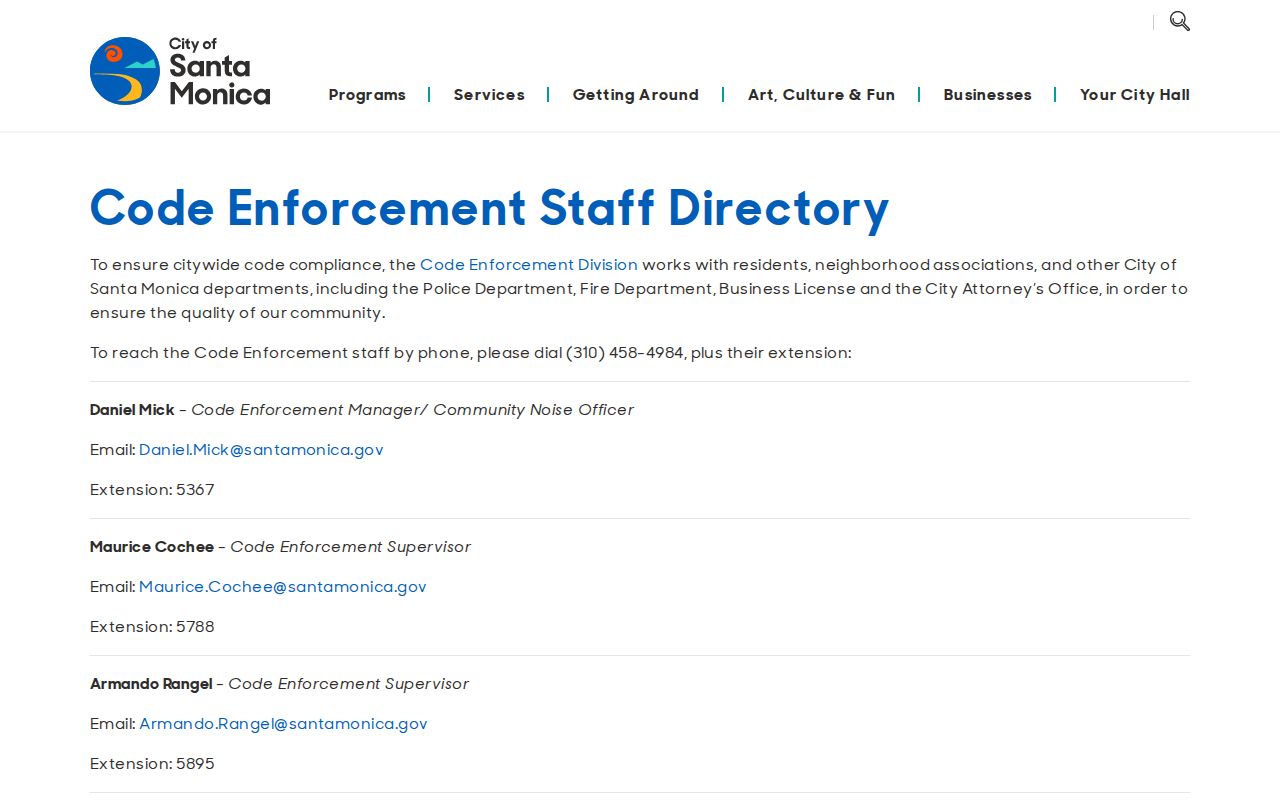
The listing shows why a department roster works best when the person's public role is already known: title, extension, and email sit together.
- Person
- The staff member's full name.
- Public role
- A manager, supervisor, or officer title.
- Work email
- The city email address when published.
- Phone
- The department main number and staff extension.
The California Personnel Office Directory fills a different need. It points to state personnel and payroll offices by agency or campus. It is useful for reaching an office, but it should not be read as a complete directory of all state workers.
Santa Monica Education Directories
The SMMUSD Staff Directory covers district staff and schools such as Santa Monica High, Lincoln, John Adams, SMASH, Grant, McKinley, Roosevelt, Edison, and Will Rogers. Its entries may show a name, department or role, extension, and email. School or section navigation helps narrow a common surname to the right campus.
| Search element | Control | What it does |
|---|---|---|
| Search | Text field | Finds matching directory content |
| Clear | Button | Removes the current query |
| School navigation | Links or menus | Moves to a campus or section |
| Staff entry | Result listing | Shows name, role, extension, and email |
The district directory screen is shown in the captured image.
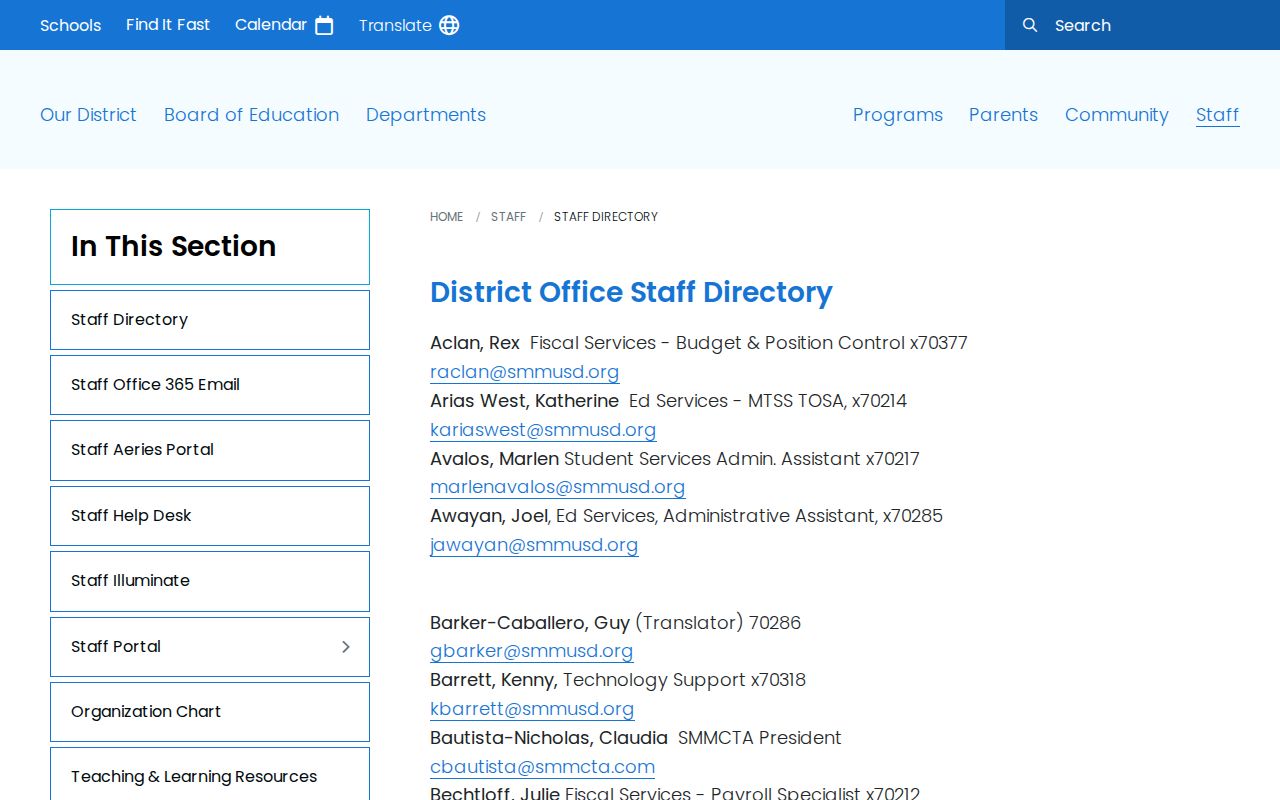
Its search and campus structure distinguish an institutional directory from a broad resident finder.
Santa Monica College's directory uses a compact table with name and title, department, email, and phone. The official source view appears below.
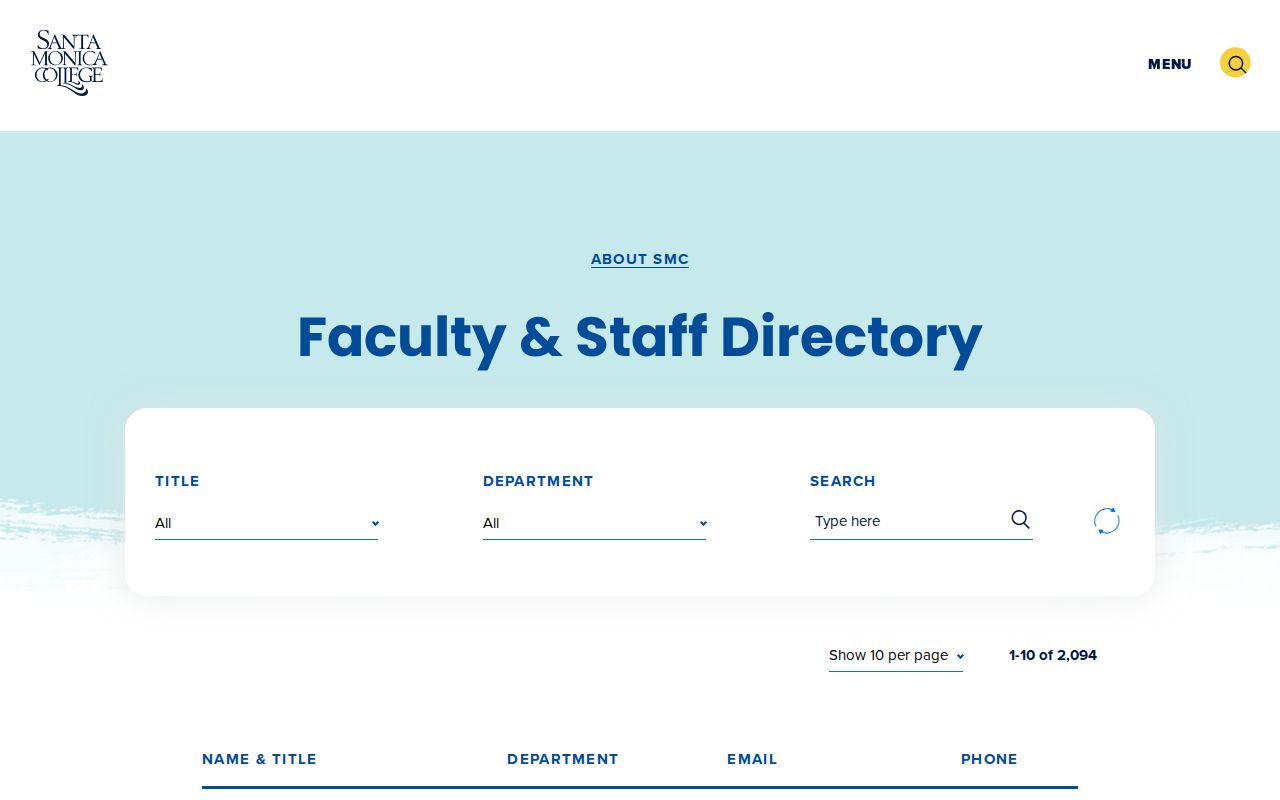
The departmental column helps separate people with similar names and confirms their institutional context.
Santa Monica Business Name Directories
The Santa Monica Business License Directory searches active local licenses by license number, business name, or category. It can connect a trade name with a local business record, but it does not replace California entity filings or a county fictitious business name record.
Confirm a likely match through the California Secretary of State business search. Its filings can show an entity number, status, jurisdiction, agent for service, addresses, and free filing PDFs. A Chamber listing is a member directory rather than an official record, so use it for community context and verify the firm's legal status through the city and state sources.
Compare the business name, address, and agent across sources. Similar names do not prove that two entries concern the same firm.
Professional Directories for Santa Monica
California's licensing systems organize people by regulated work. The Department of Consumer Affairs License Search can filter by board or bureau, license type, license number, and name. Results may show whether a license is current or expired and whether public discipline appears. Its board list spans fields from accountancy and architecture to medicine, nursing, funeral services, security, and veterinary practice.
The Contractors State License Board lookup has separate searches for a license number, contractor business name, or a person's last and first name. A name query can return no more than 100 matches, so add detail when the result set is broad. These professional directories confirm a public license relationship, not a private home address.
Note: Pair a professional listing with the Santa Monica business directory when the person or firm claims a local base.
Property Records as Directories
The Los Angeles County Assessor Portal links an address or Assessor Identification Number, called an AIN, to assessment records. The city public parcel map adds boundaries and map context but excludes ownership information. That split matters. A parcel shape alone is not an owner directory.
Recorded deeds list parties, yet the Los Angeles County Registrar-Recorder/County Clerk does not publish its real estate name index on the internet. The official grantor and grantee indexes are reviewed by name and recording year at Norwalk, by appointment. A grantor transfers an interest; a grantee receives it. Records from 1851 through 1957 are reviewed on the lower level, while records from 1958 onward are on the second floor. Once the document details are known, copies can be ordered through the county's approved channel.
- Situs address
- The physical location of the Santa Monica parcel.
- Mailing address
- The address used for owner or taxpayer correspondence.
- AIN
- The county's Assessor Identification Number for a parcel.
- Grantor and grantee
- The parties transferring and receiving a recorded interest.
Historical Santa Monica Directories
The Sharla P. Boehm Santa Monica city directory collection at the Santa Monica Public Library is the city's signature historical directory source. The research identifies 63 volumes, with a large digitized subset. Entries can preserve resident names, spouses, occupations, firms, and street addresses. A city directory reflects a particular publication year, so gaps or a missing name should be checked against nearby volumes.
The library's research and local history resources provide the broader route into photographs, newspapers, maps, and community collections. The captured collection page is linked here through the digital directory archive.
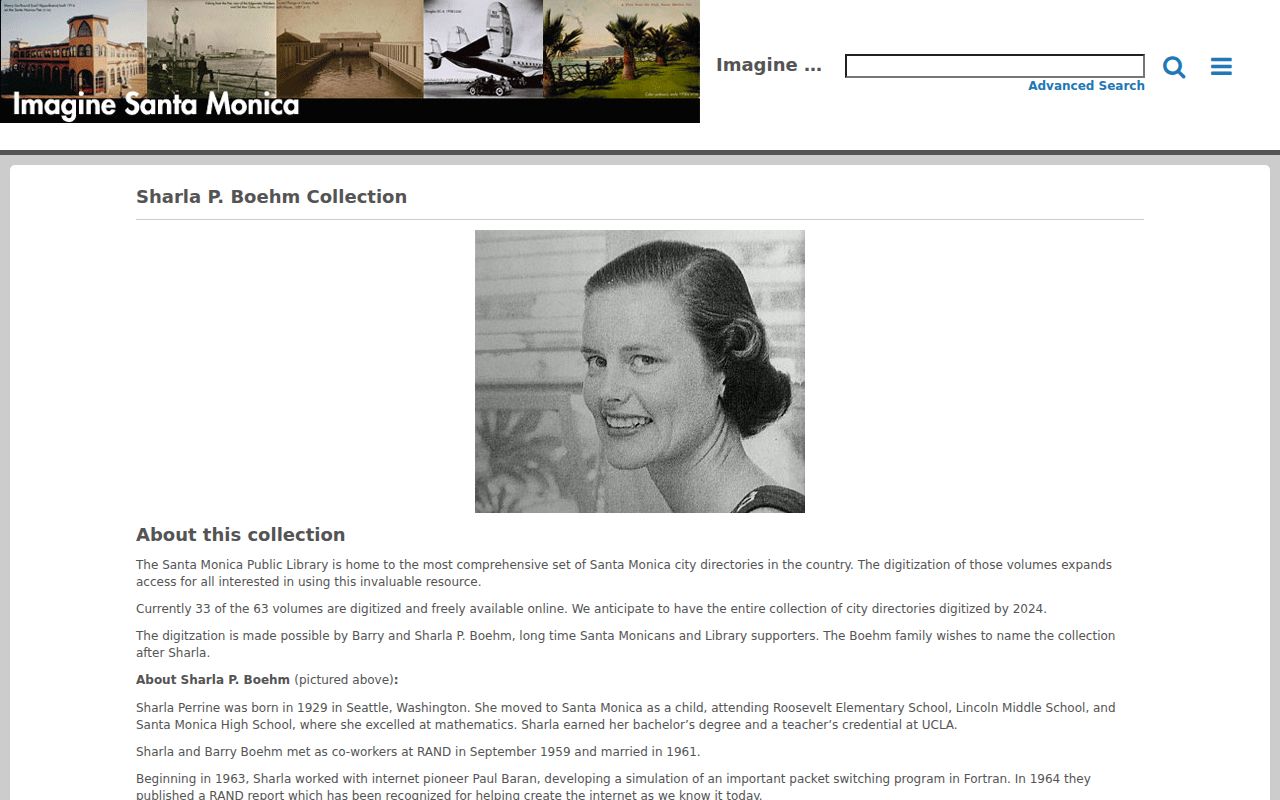
The digitized shelves turn a past address or surname into a year-by-year search rather than a single modern result.
| County recorder era | Real estate records reach 1850 or 1851 |
|---|---|
| Regional directories | LAPL digitized selections span 1875 through 1987 |
| Local phone books | History Museum holdings date from 1913 |
| Court name index | Online coverage starts in the 1980s or 1990s by case type |
Museum Directories Reconnect Families
The Santa Monica History Museum Research Library accepts research requests about people, homes, buildings, and businesses. Its holdings include more than 200 telephone directories dating back to 1913, plus yearbooks, newspapers, maps, rare books, and Chamber publications. Access is by appointment, which makes a focused name, address, school, or date range useful when asking for help.
This collection can bridge a family-history gap that official portals do not cover. A telephone book may place a household in one year; a yearbook can connect a name to a school; a newspaper can add an event or relationship. The Los Angeles Public Library street directories, covering digitized selections from 1875 to 1987, also permit reverse research from an address to a past occupant.
Santa Monica Address Directory Geography
A Santa Monica address can appear as a street listing, an assessor parcel, a legal description, and a historical directory entry. Each form points to a different keeper. The city parcel layer shows mapped land, the Assessor connects the parcel to assessment data, permits can identify applicants or contractors, and city books can reveal who was listed there in a given year.
- Check a city or street directory for the name or old address.
- Use the assessor and parcel map to identify the current parcel context.
- Search the permit archive for address-based city documents.
- Consult the recorder's name-and-year index for the deed chain.
ZIP codes such as 90401 through 90405 are postal areas, not exact legal boundaries. City GIS and county parcel records provide the firmer jurisdiction check. This is especially useful when an address sits near a city edge or changes form across old directories.
Keep Directory Matches on Record
A directory result is a lead tied to that source's purpose and date. Public employee pages change with staff moves. Business licenses may reflect an active account but not every state filing. Historical books capture a past household, not a current one. Restricted voter information is not an open resident directory, and its use is governed by California Elections Code section 2194.
Write down the source, date, spelling, role, address, and any identifier shown. Then confirm material facts with the official keeper. The access rules for county and city records are covered in the Santa Monica public records system. Lawful family, historical, civic, and consumer-safety research benefits from a careful source trail, while harassment or misuse of personal data is prohibited.